TSAL Electronic Design for Racing Vehicle
This blog presents the design and development of a Tractive Active System Light (TSAL) for a racing vehicle. The project focuses on creating a reliable electronic circuit to monitor traction and ensure safe vehicle operation under all conditions. It covers the complete process, from understanding the system’s logic and establishing its truth table, to designing, simulating, and testing the electronic components. The blog highlights the challenges of translating safety-critical functions into practical, high-performance hardware for motorsports applications.
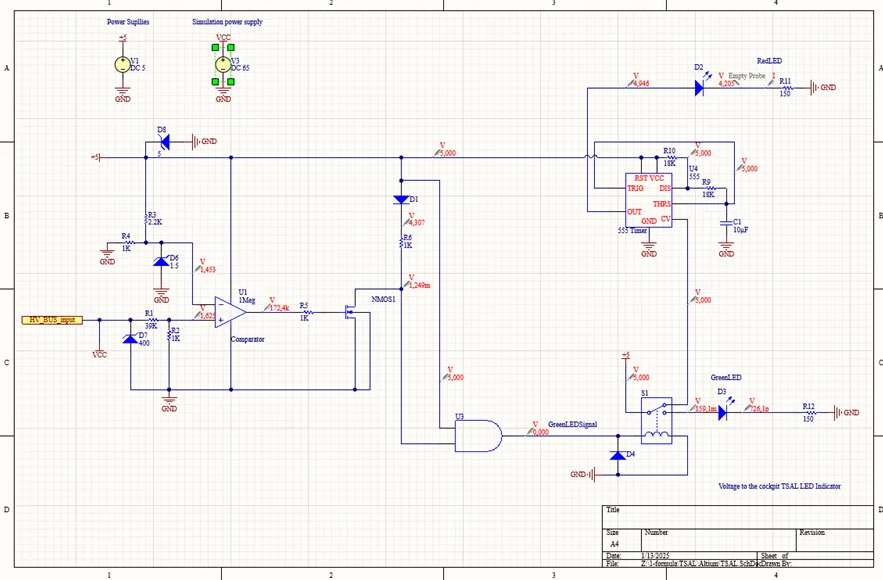

In addition to my work on the BMS, I am also leading a team focused on designing an analog TSAL (Tractive Active System Light) system. Our goal is to understand and replicate the functioning of a TSAL in a simplified, analog form, which will provide insights into signal processing, safety logic, and real-time control in automotive systems.
The project began with a detailed study of how TSAL systems operate. I started by analyzing its logic behavior and establishing the truth table, which defines the system’s responses under different input conditions. Once I had a clear understanding, I explained the concept and workflow to my team members, ensuring everyone could contribute effectively to the design and implementation process.
The plan is to start development in January 2026 and complete the project by June 2026. The technical work will involve designing analog circuits that replicate the logic behavior of the TSAL, including sensors input handling, signal conditioning, and fail-safe mechanisms. We will also simulate and test the circuit to ensure it responds correctly to various scenarios, mimicking real automotive conditions.
This project is not only a technical challenge but also a valuable exercise in team coordination, teaching, and translating complex digital logic into an analog implementation, which provides a deeper understanding of automotive safety systems and embedded control.